.jpg)
2026/01/19
How to Navigate the Legacy Blog of Henri van Bentum, 1929 - 2022

2026/01/17
"What The Critics Say" -- about the work of the late Henri van Bentum, Artist

Henri van Bentum at work on a "Spatial Rhythm" watercolour, Arizona, 2015
“His microscopic attention to detail comes out most strongly in evocations of coral seen through the luminous waters of tropical seas, and in the textures of rock and ice caught in the suffused light of underground caverns.” TIME Magazine
“The best one-man show of abstract art I have seen in a long time is that of watercolours by Henri van Bentum. While too many artists seem to torture watercolour for expression, van Bentum exploits the natural delight of the medium so that it serves his most exacting thought.” Globe & Mail
“Henri van Bentum’s series of work, “Spatial Rhythms”, reflects his development into a controlled, simple interpretation of inner feelings; this series of paintings interprets the elements of music such as volume, mood and rhythm and are translated into tonality, colour and composition." Whyte Museum of the Canadian Rockies, Banff, Alberta
"When he marshals his colour into circles, then places them like water drops on the white canvas, van Bentum gets a rich intricacy of light and depth. Some have jewel facets, while others contain the subtleties of earth, leaves and bark". Globe & Mail
“Viewing a painting by Henri van Bentum is a stimulus to the imagination. Perhaps his background as a diamond-faceter’s son is responsible for the almost crystalline aspect of his work. The single most extraordinary quality in all his paintings is an incredible luminosity, a radiance that emanates from within.
Completely introspective in his work, van Bentum is probably a born abstract painter. J.W.G. ("Jock") Macdonald, with whom he studied, was one of the first to encourage van Bentum to develop his individuality, and it is certainly under Macdonald’s influence that he achieved his present independence. van Bentum uses blank space as a positive.
The missing element is essential to the whole. While none of his current work depicts any recognizable object, it immediately conjures up a mental word picture of a time, space, melody or situation”. Canadian Interiors
2024/11/14
Works by the late Henri van Bentum from our Private Collection. Now available to purchase for the first time.

Before his passing on April 2nd 2022 at the age of 92, artist Henri van Bentum authorized me, Natasha van Bentum, his partner of 51 years, to make available a few of his paintings from our Private Collection.
Please note: several of these paintings have not come onto the market for many years, and include works from the late 1950's and early 1960's. (See the end of this post for "What the Critics Say about the Work of Henri van Bentum.")

Henri van Bentum, "Global WarNing", 1965
Acrylic and Chinese Ink on Paper, width 30" x height 24", framed under glass
Acrylic and Chinese Ink on Paper, width 30" x height 24", framed under glass
Exhibited at Roberts Gallery, 1965
Painted long before "global warming" became a common term.
Formerly in the private collection of Mr. Leslie George Dawson

Henri van Bentum, "Veined Ripples", 1965
Acrylic on canvas, width 30" x height 24"
Exhibited in Paris, France in 1966,
at Galerie Raymonde Cazenave, Paris, France 1966
Reproduced in TIME Magazine, May 20, 1966
Formerly in the collection of the late Mr. Leslie George Dawson.

Henri van Bentum, "Long Before", 1967
Acrylic on canvas, width 40" x height 50", framed
Formerly in the collection of the late Mr. Leslie George Dawson

Henri van Bentum, "Season", 1962
Oil on canvas, width 26" x height 30", framed
Painted while living on the island of Ibiza, Spain
From the private collection of the late Mr. Leslie George Dawson

Acrylic on canvas, width 40" x height 30", framed
Painted while living in Ottawa, Ontario, 1977-78

Henri van Bentum, "Jubilato", 1977
Acrylic on canvas, width 30" x height 36"
Painted while living in Ottawa, Ontario, 1977-78
Formerly in the collection of the late Mr. Leslie George Dawson

Henri van Bentum, "Borealis", 1964
Acrylic on paper, width 30" x height 24", framed under glass
Exhibited at Roberts Gallery, 1965
The only remaining work available in this series
SPATIAL RHYTHMS Series - Watercolour on handmade paper
About the Spatial Rhythms series: While living in the Rocky Mountains (in Banff, Alberta), van Bentum began a bold, Zen-like series of watercolours that he named "Spatial Rhythms". Henri continued working on this "Spatial Rhythms" series after moving to Vancouver in 1985.
"Spatial Rhythms" are a controlled, simple interpretation of inner feeling and symbolism. The work contains elements of music -- such as volume, mood and rhythm, which are translated into tonality, colour and composition."

Example of Henri van Bentum's Spatial Rhythms series, 1983
Watercolour on handmade paper, width 20", height 30"
Vertical series, created while living in Banff, Alberta 1980-85.

Example of Henri van Bentum's Spatial Rhythms, 1983
Watercolour on handmade paper, width 20", height 30"
Horizontal series, created while living in Banff, Alberta 1980-85.
What the Critics Say about the Work
of Artist Henri van Bentum
van Bentum uses blank space as a positive. The missing element is essential to the whole. While none of his current work depicts any recognizable object, it immediately conjures up a mental word picture of a time, space, melody or situation”. Canadian Interiors
Contact: Natasha van Bentum
vanbentum "at" gmail.com
2024/04/23
"Fruit Gathering" / "Organiverse"

Fruit Gathering: A Journey Into the "Organiverse" of Henri van Bentum, with Rabindranath Tagore - Part Two
With a focus on Light this contemplative online exhibit features a series of ten sequential video and audio chapters embracing one hundred mandalas ("Organiverse" Starry Night edition, created by artist Henri van Bentum) with the eighty-six poems, "Fruit Gathering" by Tagore, exploring themes of light and life. Read by producer Brian W.E. Johnson.

Mandala #25 from #100 set, Organiverse, Henri van Bentum, 1972
Join us as we explore Rabindranath’s epic work “Fruit Gathering”, comprised of eighty-six poems, paired with the 100 mandalas of Henri van Bentum’s “Organiverse – Starry Night edition”.
Each poem is read by producer Brian W.E. Johnson.
Just as Rabindranath Tagore uses light as a symbol for hope and freedom, and to represent divine love, Henri van Bentum’s Organiverse series is a glimpse into the multi-layered beauty of all that is life and light, a dance of colour, form and contemplation.
Link to the full playlist:
https://www.youtube.com/watch?v=wfQ6s0ImVvw
This project is a sequel to the "Gitanjali/Organiverse" exhibit, described in our post of January 5, 2022. For full details click here.
More about Organiverse, both the Original and Starry Night editions, can be found here.
For a link to the special issue of "Gitanjali and Beyond", Issue #7. published by the Scottish Centre of Tagore Studies, click here.
2024/04/01
Remembering With Joy, Artist Henri van Bentum (1929-2022), and the healing power of Art
On the Healing Power of Art
"Henri, the 'Maestro',
lives on in our hearts and minds
every day." Natasha van Bentum

Henri van Bentum,
1929-2022
Tuesday, 2nd April marked the second anniversary of Henri's passing. Henri often spoke of the healing power of art. He was acutely aware of this, having begun to paint while in a tuberculosis sanatorium in the Netherlands after WWII. The doctors said painting was a major factor in his recovery.
Over the past two years, I have found his paintings here in our private collection have brought both solace and much joy.
Here are a few words by others about Henri's work, as well as s short 'poem' Henri wrote many years ago, "What Is A Creative Person Like?"
≈≈≈
“The brightness that leaps from his canvasses is like crystals seen through a microscope.” TIME
≈≈≈
“Henri was generous with his heart and his mind, always creative. He set a high-water mark for a life lived with integrity, focus and compassion.” Marina Bieler

≈≈≈
“As an artist and colour master, Henri van Bentum captured light and life, creating something beautiful, a choreography of colour and texture. In Henri’s hands, the Universe danced.” Dr. Kimberly Kowal, NASA
≈≈≈
“Viewing a painting by Henri van Bentum is a stimulus to the imagination. Perhaps his background as a diamond-faceter’s son is responsible for the almost crystalline aspect of his work. The single most extraordinary quality in all his paintings is an incredible luminosity, a radiance that emanates from within.” Globe and Mail

≈≈≈
“Henri van Bentum’s opus, Organiverse, is a glimpse into the multi-layered beauty of all that is Life. These mandalas offer an immense opportunity for healing and for a heart-based understanding of who we are physically, emotionally and spiritually. A dance of colour, form and contemplation.” Dr. Mark Sherman

≈≈≈
“Henri lived with enhanced fluid sensitivity, especially to colour, nuances of form, and shades and combinations… and, in addition to paying careful attention to detail, Henri embodied an expanded, or perhaps better said, an unblemished sense of wonder.
These combinations and receptive qualities help to explain how and why Henri would often enhance situations and people simply by his presence, and this in turn, would inspire creativity and highlight beauty, in many diverse situations.” Brian W.E. Johnson
≈≈≈
"While Henri is known as an abstract artist, his approach to the abstract is distinctive - perhaps it might be called an abstract ecology. It is this unique perspective in his art that invites a sense of connection to realities beyond the ordinary appearance of things - both to the cosmos, but also to the biological. In his abstractions, we see the resonance of the microcosm and macrocosm." Seonaigh MacPherson

≈≈≈
What is a Creative Person Like? (written by Henri many years ago)
Are observant of the world
about them
Are aware of the feel and
touch of things
Listen to the sound of
life around them
Are sensitive to smell
Are aware of the taste of
things
THEY LIKE TO ‘BUILD’ THEIR IDEAS
Like to construct things
in material
Prefer to rearrange old
ideas into new relationships
Like to experiment with
various approaches and media
Like to try out new
methods and techniques
Prefer to manipulate their
ideas in various ways
Have to solve problems set
by themselves
Seek to push beyond the
boundaries of their thinking
THEY LIKE TO EXPLORE NEW IDEAS
Are original in their
thoughts about things
Like to invent new ways of
saying and telling
Like to dream up new
possibilities
Like to imagine and
pretend
THEY ARE CONFIDENT IN THEMSELVES
Flexible in approaches to
situations
Like to be independent and
on their own
Are outwardly expressive
of what they have to say
Are not afraid of
emotional feelings and show them
THEY LIKE TO INVESTIGATE THE NATURE OF THINGS
Like to search for the meaning of things
Question available data
and information
Like to inquire into
unknown quantities
Discover new relationships
Desire to uncover new
meanings
THEY RESPOND TO AESTHETIC STIMULI
Are sensitive to the
beauty of nature
Appreciate beauty man has
made and
Which nature abundantly
provides
Have feeling for harmony
and rhythm
Love to sing, write,
explore, cook,
act, sculpt, draw, paint
or dance.

For those who missed it, here is the link to Henri's obituary.
Posted by Natasha van Bentum,
Henri's lifelong partner of 51 years
2023/10/17
Honouring Namgyal Rinpoche (b.1931) on the 20th anniversary of his passing on October 22, 2003

[Editor's Note: Back in 2015, Henri shared a few of his many experiences from his time with Rinpoche. Here he writes about Namgyal and art. I thought it would be timely to share this essay for the commemoration on the 20th anniversary of Namgyal's passing, October 22, 2003.]
Written by Henri in 2015:
"Rinpoche’s interests
encompassed a 360° view on all the arts.
The Seven Muses, so to speak.
When I met him as Ananda Bodhi in late 1966, I never told him I was an
artist. Other Dharma students mentioned
it to him, I guess.
Once he knew I was an artist, he asked me about the local art scene and we had dialogues about the evolution of Art.
The Teacher was curious and interested in everything. His breadth of knowledge and insight included the Arts, including opera.
Being the mentor and teacher that he was, Rinpoche said “We should try to make a work of art of ourselves, not just works of art.”
Namgyal was familiar with the work of several renowned artists, but I also recall him mentioning in particular Cornelius Krieghoff, Georges Rouault, Jock Macdonald (my art mentor), Lawren Harris, and also Henri Matisse.
Art and Travel
When it comes to Art and travel, there are many examples of Rinpoche’s interests manifesting themselves in countless ways and encouraging us to explore.
In the autumn of 1967, Ananda Bodhi had asked students who would be interested in joining him on a pilgrimage to India (by freighter), to put their names on a list. I was asked to find a ship for the voyage.
A few phone calls to Europe anchored a freighter of the Ned Lloyd line of Holland (KNSM) which could carry ten passengers, sailing from western Europe in late November or early December to India.
Meanwhile, twenty-seven students had shown interest. The Teacher scaled this down to eight, plus himself and Tony Olbrecht (Sonam), his attendant.
To get to Europe, there was only one remaining transatlantic crossing available since it was late in the season - the Russian vessel Aleksandr Pushkin - sailing from Montreal in November to Southampton.
Freighters have unpredictable departure and arrival schedules. Ananda Bodhi had decided to sail on the Pushkin in order to arrive early in England and Europe and do some traveling there. The Atlantic crossing took nine days.
En route to our first pilgrimage in 1967 to India, Ceylon and Burma, as it was known then, we sailed across the Atlantic and spent some time in Europe before embarking on a freighter in Le Havre.
While on European soil, the Teacher suggested we travel to the prehistoric caves of Lascaux of France. There, we had the rare privilege of a special tour with a guide, even though officially the caves were closed to the public. Also, in Spain, at Ananda Bodhi’s suggestion, we visited the caves of Alta Mira, before embarking on a freighter to India.
Being on Your Toes
You always had to be on your toes during these trips. We boarded the freighter (“Giessenkerk”) in Le Havre which would be sailing the next day.

I’d only just embarked and
was looking forward to quietly exploring the vessel, operated by a Netherlands
company.
Ananda Bodhi however had something else in mind: “Henri”, he said, “I want you to go the Paris right now and see the major exhibition of Henri Matisse”.
So, of course, I obeyed, although I was a bit anxious to get back in time before the ship sailed for our lengthy voyage.
I took in the exhibition in its entirety and reported back to the Teacher who was interested to hear all about it, and gave him the exhibition catalogue.
Elsewhere I’ve written extensively about our voyage aboard the “Giessenkerk”, It was aboard this trip that he first asked me to give him some pointers and help with oil pastels.
At another time, back in Toronto, we also created batiks together (below is a photo of one of them).

A large Batik wall hanging Henri van Bentum and Namgyal Rinpoche created together in 1968
3 feet x 5 feet
Collection Natasha van Bentum
Other artist we discussed were Mondriaan, the pioneer of abstract art, and of Mondriaan’s interest in Theosophy and the Mysteries. Likewise, about my former art teacher J.W.G. (“Jock”) Macdonald.
Namgyal said most artists had lots of ‘knowing’ but were lacking in balancing this with ‘being’. He told me Georges Braque was a better artist than Picasso, but because Braque was not a promoter of his own work (which Picasso excelled in), the world didn’t know too much about him.
One day, Rinpoche told me, “Henri, Art is your vehicle for unfolding.”
A few years later, while we were on a retreat in Morocco (1972), for the very first time Namgyal made a suggestion to me about a technique in art.
He said I should try Pointillism because it is an excellent method for concentration, patience and meditation.
How he knew, I’ll never understand, but it turned out this technique came very naturally to me and marked a whole new era of exploration that continues to this day.
At that time, we were in Essaouira on the Atlantic coast of Morocco. The winds from the Sahara brought sand everywhere, including on the artwork.
I asked permission to leave the retreat, in order to continue working in this new technique. He consented, and so Natasha and I left for Madeira, where I completed my 100 mandalas that I named “Organiverse”. (Which took on a life of its own, but that’s another story.)
When all 100 mandalas were finished, I returned to Morocco to show Namgyal, but he had left for Spain. None of the other students knew where he was staying.
No matter, I found him and showed him the 100 "Organiverse" mandalas. “I knew it!” he said, turning to Sonam, then he said again “I knew it!”

This is just one painting (#23) from the #100 set, ORGANIVERSE,
Henri van Bentum
Watercolour pencil on paper, 8.5 cm diameter, 1972
A video of the full set of all 100 ORGANIVERSE mandalas is available here on Vimeo.
Later, Rinpoche began to do some small abstract images, many of which found their way to Dharma bazaars or the homes of Dharma students who eagerly acquired them. Natasha and I also have a couple.
Several years ago, a large format illustrated book was published, "Unfolding Through Art - Namgyal Rinpoche", by Bodhi Publishing but is currently out of print.

I’ve written elsewhere about what an extraordinary and precious being Rinpoche was. He was also what I call an “all rounded” man - - he knew about art, music, poetry, sculpture, theatre, fairy tales, and of course the Western Mysteries, and was a master meditation Teacher.
With his extraordinary travels and exploring, I called Namgyal "The Hero of a Thousand Places”.

Namgyal Rinpoche, Terry Hagan (partial view) and Henri van Bentum, the Philippines, 1978, with two guides
Henri van Bentum,
Victoria, BC, 2015
& posted by Natasha van Bentum, October 2023
2023/05/27
The Deployment of Henri's Reef off the coast of Vancouver Island - Artist Henri van Bentum, 1929-2022

"Coral Fantasy", acrylic on paper, 1965 Henri van Bentum, Private Collection
In Loving Memory: Saturday, May 27th marked the deployment of Henri’s reef into the Salish Sea off the coast of Vancouver Island, at a dive and snorkelling site located near the Ten Mile Point ecological reserve.
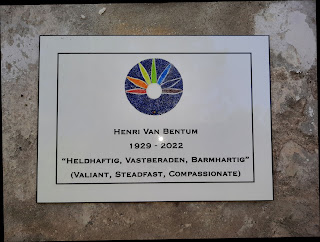
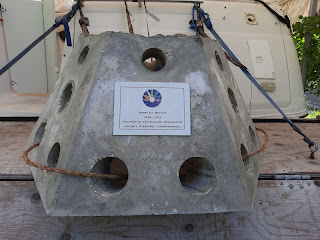 Thanks to the people at Living Reef Memorial, the reef was created from Henri’s cremated ashes, crushed oyster and other seashells, low alkaline cement and sand. The reef has a ceramic plaque honouring Henri.
 Just some of the underwater life (*) that can be found in Spring Bay, with its cold and strong currents are: frosted nudibranch, painted anemone, pink-tipped aggregating anemone, giant plumrose anemone, shiny sea squirt, three types of chiton, plus three types of dorid (leopard, Heath and Hudson), clown nudibranch, mottled star, blood star, green urchin, red urchin, purple urchin, and three kinds of sea cucumber. (*) For this listing, thank you to Sara Ellison, author of the newly-published "Snorkelling Adventures Around Vancouver Island and the Gulf Islands".


Soon Henri’s reef will be visited and inhabited by many underwater creatures.
For many years, Henri went on snorkelling / dive expeditions to such faraway locations as the Solomon Islands, Fiji and Indonesia. He had a great love for all creatures of the seven seas.
In addition to circumnavigating the planet by ship three times, in his eighth decade Henri wrote five children’s books, three of which feature coral reefs and the sea.
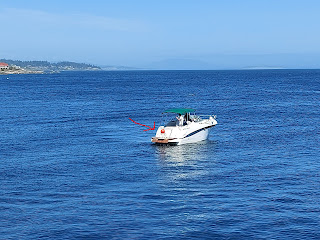

In the photo above, the arrow points to the reef at the back of the boat, about to be deployed.
I only learned about Living Reef Memorial after Henri left us to continue his journey, but I know he would have found joy in the concept of “from cremation to creation”.
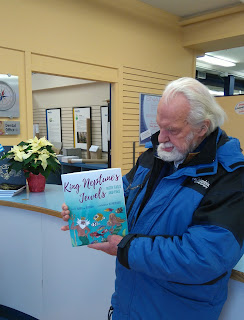

Here is a photo of Henri, back in in 2017, with his first children's book,
"King Neptune's Jewels with Fins and Tails", hot off the press
Natasha van Bentum
Henri's partner of 51 years
Subscribe to:
Comments (Atom)

 Posts
Posts


