.jpg)
2024/04/24
How to Navigate the Legacy Blog of Henri van Bentum, 1929 - 2022

2024/04/23
Celebrating the International Day of Light 2024 - "Fruit Gathering" / "Organiverse"

Fruit Gathering: A Journey Into the "Organiverse" of Henri van Bentum, with Rabindranath Tagore - Part Two
With a focus on Light this contemplative online exhibit features a series of ten sequential video and audio chapters embracing one hundred mandalas ("Organiverse" Starry Night edition, created by artist Henri van Bentum) with the eighty-six poems, "Fruit Gathering" by Tagore, exploring themes of light and life. Read by producer Brian W.E. Johnson.


Mandala #25 from #100 set, Organiverse, Henri van Bentum, 1972
Join us as we explore Rabindranath’s epic work “Fruit Gathering”, comprised of eighty-six poems, paired with the 100 mandalas of Henri van Bentum’s “Organiverse – Starry Night edition”.
Each poem is read by producer Brian W.E. Johnson.
Just as Rabindranath Tagore uses light as a symbol for hope and freedom, and to represent divine love, Henri van Bentum’s Organiverse series is a glimpse into the multi-layered beauty of all that is life and light, a dance of colour, form and contemplation.
Link to the full playlist:
https://www.youtube.com/playlist?list=PLimVRC0ywrmjNrYPJkFNqLRqim15PMpK0

This project is a sequel to the "Gitanjali/Organiverse" exhibit, described in our post of January 5, 2022. For full details click here.
More about Organiverse, both the Original and Starry Night editions, can be found here.
For a link to the special issue of "Gitanjali and Beyond", Issue #7. published by the Scottish Centre of Tagore Studies, click here.

2024/04/01
Remembering With Joy, Artist Henri van Bentum (1929-2022), and the healing power of Art
On the Healing Power of Art
"Henri, the 'Maestro',
lives on in our hearts and minds
every day." Natasha van Bentum

Henri van Bentum,
1929-2022
Tuesday, 2nd April marked the second anniversary of Henri's passing. Henri often spoke of the healing power of art. He was acutely aware of this, having begun to paint while in a tuberculosis sanatorium in the Netherlands after WWII. The doctors said painting was a major factor in his recovery.
Over the past two years, I have found his paintings here in our private collection have brought both solace and much joy.
Here are a few words by others about Henri's work, as well as s short 'poem' Henri wrote many years ago, "What Is A Creative Person Like?"
≈≈≈
“The brightness that leaps from his canvasses is like crystals seen through a microscope.” TIME
≈≈≈
“Henri was generous with his heart and his mind, always creative. He set a high-water mark for a life lived with integrity, focus and compassion.” Marina Bieler

≈≈≈
“As an artist and colour master, Henri van Bentum captured light and life, creating something beautiful, a choreography of colour and texture. In Henri’s hands, the Universe danced.” Dr. Kimberly Kowal, NASA
≈≈≈
“Viewing a painting by Henri van Bentum is a stimulus to the imagination. Perhaps his background as a diamond-faceter’s son is responsible for the almost crystalline aspect of his work. The single most extraordinary quality in all his paintings is an incredible luminosity, a radiance that emanates from within.” Globe and Mail

≈≈≈
“Henri van Bentum’s opus, Organiverse, is a glimpse into the multi-layered beauty of all that is Life. These mandalas offer an immense opportunity for healing and for a heart-based understanding of who we are physically, emotionally and spiritually. A dance of colour, form and contemplation.” Dr. Mark Sherman

≈≈≈
“Henri lived with enhanced fluid sensitivity, especially to colour, nuances of form, and shades and combinations… and, in addition to paying careful attention to detail, Henri embodied an expanded, or perhaps better said, an unblemished sense of wonder.
These combinations and receptive qualities help to explain how and why Henri would often enhance situations and people simply by his presence, and this in turn, would inspire creativity and highlight beauty, in many diverse situations.” Brian W.E. Johnson
≈≈≈
"While Henri is known as an abstract artist, his approach to the abstract is distinctive - perhaps it might be called an abstract ecology. It is this unique perspective in his art that invites a sense of connection to realities beyond the ordinary appearance of things - both to the cosmos, but also to the biological. In his abstractions, we see the resonance of the microcosm and macrocosm." Seonaigh MacPherson

≈≈≈
What is a Creative Person Like? (written by Henri many years ago)
Are observant of the world
about them
Are aware of the feel and
touch of things
Listen to the sound of
life around them
Are sensitive to smell
Are aware of the taste of
things
THEY LIKE TO ‘BUILD’ THEIR IDEAS
Like to construct things
in material
Prefer to rearrange old
ideas into new relationships
Like to experiment with
various approaches and media
Like to try out new
methods and techniques
Prefer to manipulate their
ideas in various ways
Have to solve problems set
by themselves
Seek to push beyond the
boundaries of their thinking
THEY LIKE TO EXPLORE NEW IDEAS
Are original in their
thoughts about things
Like to invent new ways of
saying and telling
Like to dream up new
possibilities
Like to imagine and
pretend
THEY ARE CONFIDENT IN THEMSELVES
Flexible in approaches to
situations
Like to be independent and
on their own
Are outwardly expressive
of what they have to say
Are not afraid of
emotional feelings and show them
THEY LIKE TO INVESTIGATE THE NATURE OF THINGS
Like to search for the meaning of things
Question available data
and information
Like to inquire into
unknown quantities
Discover new relationships
Desire to uncover new
meanings
THEY RESPOND TO AESTHETIC STIMULI
Are sensitive to the
beauty of nature
Appreciate beauty man has
made and
Which nature abundantly
provides
Have feeling for harmony
and rhythm
Love to sing, write,
explore, cook,
act, sculpt, draw, paint
or dance.

For those who missed it, here is the link to Henri's obituary, published two years ago.
Posted by Natasha van Bentum,
Henri's lifelong partner of 51 years
2023/05/27
The Deployment of Henri's Reef off the coast of Vancouver Island - Artist Henri van Bentum, 1929-2022

"Coral Fantasy", acrylic on paper, 1965 Henri van Bentum, Private Collection
In Loving Memory: Saturday, May 27th marked the deployment of Henri’s reef into the Salish Sea off the coast of Vancouver Island, at a dive and snorkelling site located near the Ten Mile Point ecological reserve.
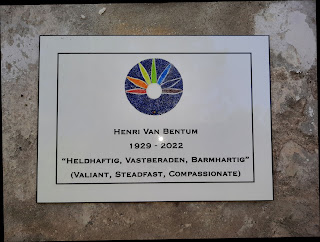
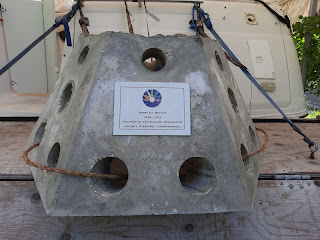 Thanks to the people at Living Reef Memorial, the reef was created from Henri’s cremated ashes, crushed oyster and other seashells, low alkaline cement and sand. The reef has a ceramic plaque honouring Henri.
 Just some of the underwater life (*) that can be found in Spring Bay, with its cold and strong currents are: frosted nudibranch, painted anemone, pink-tipped aggregating anemone, giant plumrose anemone, shiny sea squirt, three types of chiton, plus three types of dorid (leopard, Heath and Hudson), clown nudibranch, mottled star, blood star, green urchin, red urchin, purple urchin, and three kinds of sea cucumber. (*) For this listing, thank you to Sara Ellison, author of the newly-published "Snorkelling Adventures Around Vancouver Island and the Gulf Islands".


Soon Henri’s reef will be visited and inhabited by many underwater creatures.
For many years, Henri went on snorkelling / dive expeditions to such faraway locations as the Solomon Islands, Fiji and Indonesia. He had a great love for all creatures of the seven seas.
In addition to circumnavigating the planet by ship three times, in his eighth decade Henri wrote five children’s books, three of which feature coral reefs and the sea.
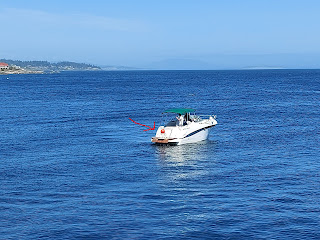

In the photo above, the arrow points to the reef at the back of the boat, about to be deployed.
I only learned about Living Reef Memorial after Henri left us to continue his journey, but I know he would have found joy in the concept of “from cremation to creation”.
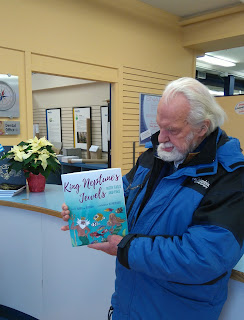

Here is a photo of Henri, back in in 2017, with his first children's book,
"King Neptune's Jewels with Fins and Tails", hot off the press
Natasha van Bentum
Henri's partner of 51 years
2023/05/26
More photos from the deployment of Henri's Reef
Here are some screen captures from a video by Living Reef Memorial of the deployment of Henri's Reef exactly two weeks ago, on May 27th.
More details about the Living Reef can be found in the earlier post, published on the same day (scroll below).

The boat left from Esquimalt, en route to Ten Mile Point and the deployment site

Looking south, across Juan de Fuca Strait to the Olympic mountains


Nearing Ten Mile Point

The reef prior to deployment (Henri's plaque is on the back, not in view, see photo below)

The arrow points to the Reef about to be deployed

The ceramic plaque on Henri's Reef

Heading back home
In Loving Memory
Henri van Bentum
1929-2002
2023/05/24
Henri was a keen Snooker player, he would have enjoyed this:
This week my quasi-spoof, quasi-serious document, called "The Society for the Protection of Snooker Tables - An Endangered Species", was hung in the Billiards Room of the historic Union Club of British Columbia. My beloved partner of fifty-one years, artist and keen snooker player, Henri van Bentum, (1929-2022) would have enjoyed it.

Looking towards the west wall of the Billiards Room, the red arrow shows the framed document. There are two other full-size snooker tables in the room, shown below.

A photo of the late Henri van Bentum (1929-2022), shown in action in the Billiards Room

Natasha van Bentum
July 2023
2023/05/05
Celebrating Light: A Journey Through the Organiverse with Works by Rabindranath Tagore ("Gitanjali") and Henri van Bentum
As a way of introducing the Gitanjali / Organiverse project (see post of February15th ), we've linked up with the UNESCO International Day of Light 2023 to introduce one of Rabindranath Tagore's poems (#57, "Light") and one of Henri van Bentum's 'Organiverse' mandalas (#57 of #100 set). The site has a link to the full project, encompassing all 100 mandalas and 100 poems. https://vanbentum.wixsite.com/journey


Subscribe to:
Posts (Atom)

 Posts
Posts


