Some
remembrances about art and Namgyal Rinpoche (Ananda Bodhi), 1931-2003, by artist Henri van Bentum (1929-2022)
[Editor's Note: Back in 2015, Henri shared a few of his many experiences from his time with Rinpoche. Here he writes about Namgyal and art. I thought it would be timely to share this essay for the commemoration on the 20th anniversary of Namgyal's passing, October 22, 2003.]
Written by Henri in 2015:
"Rinpoche’s interests
encompassed a 360° view on all the arts.
The Seven Muses, so to speak.
When I met him as Ananda Bodhi in late 1966, I never told him I was an
artist. Other Dharma students mentioned
it to him, I guess.
Once he knew I was an
artist, he asked me about the local art scene and we had dialogues about the
evolution of Art.
The Teacher was curious
and interested in everything. His breadth
of knowledge and insight included the Arts, including opera.
Being the mentor and
teacher that he was, Rinpoche said “We
should try to make a work of art of ourselves, not just works of art.”
Namgyal was familiar with
the work of several renowned artists, but I also recall him mentioning in
particular Cornelius Krieghoff, Georges Rouault, Jock Macdonald (my art mentor),
Lawren Harris, and also Henri Matisse.
Art and Travel
When it comes to Art and
travel, there are many examples of Rinpoche’s interests manifesting themselves
in countless ways and encouraging us to explore.
In the autumn of 1967,
Ananda Bodhi had asked students who would be interested in joining him on a
pilgrimage to India (by freighter), to put their names on a list. I was asked
to find a ship for the voyage.
A few phone calls to Europe anchored a freighter
of the Ned Lloyd line of Holland (KNSM) which could carry ten passengers,
sailing from western Europe in late November or early December to India.
Meanwhile, twenty-seven students
had shown interest. The Teacher scaled this down to eight, plus himself and
Tony Olbrecht (Sonam), his attendant.
To get to Europe, there was only one
remaining transatlantic crossing available since it was late in the season -
the Russian vessel Aleksandr Pushkin - sailing from Montreal in November to
Southampton.
Freighters have unpredictable departure and arrival schedules.
Ananda Bodhi had decided to sail on the Pushkin in order to arrive early in
England and Europe and do some traveling there. The Atlantic crossing took nine
days.
En route to our first
pilgrimage in 1967 to India, Ceylon and Burma, as it was known then, we sailed
across the Atlantic and spent some time in Europe before embarking on a
freighter in Le Havre.
While on European soil,
the Teacher suggested we travel to the prehistoric caves of Lascaux of
France. There, we had the rare privilege
of a special tour with a guide, even though officially the caves were closed to
the public. Also, in Spain, at Ananda Bodhi’s
suggestion, we visited the caves of Alta Mira, before embarking on a freighter
to India.
Being on Your Toes
You always had to be on
your toes during these trips. We boarded
the freighter (“Giessenkerk”) in Le Havre which would be sailing the next day.
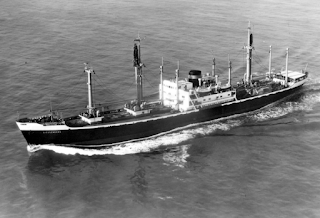
I’d only just embarked and
was looking forward to quietly exploring the vessel, operated by a Netherlands
company.
Ananda Bodhi however had
something else in mind: “Henri”, he
said, “I want you to go the Paris right
now and see the major exhibition of Henri Matisse”.
So, of course, I obeyed,
although I was a bit anxious to get back in time before the ship sailed for our
lengthy voyage.
I took in the exhibition
in its entirety and reported back to the Teacher who was interested to hear all
about it, and gave him the exhibition catalogue.
Elsewhere I’ve written
extensively about our voyage aboard the “Giessenkerk”, It was aboard this trip that he first asked me to give him some pointers
and help with oil pastels.
At another time, back in
Toronto, we also created batiks together (below is a photo of one of them).
A large Batik wall hanging Henri van Bentum and Namgyal Rinpoche created together in 1968
3 feet x 5 feet
Collection Natasha van Bentum
Other artist we discussed
were Mondriaan, the pioneer of abstract art, and of Mondriaan’s interest in Theosophy
and the Mysteries. Likewise, about my former art teacher J.W.G. (“Jock”) Macdonald.
Namgyal said most artists
had lots of ‘knowing’ but were lacking in balancing this with ‘being’. He told
me Georges Braque was a better artist than Picasso, but because Braque was not
a promoter of his own work (which Picasso excelled in), the world didn’t know
too much about him.
One day, Rinpoche told me, “Henri, Art
is your vehicle for unfolding.”
A few years later, while
we were on a retreat in Morocco (1972), for the very first time
Namgyal made a suggestion to me about a technique in art.
He said I should try Pointillism
because it is an excellent method for concentration, patience and meditation.
How he knew, I’ll never
understand, but it turned out this technique came very naturally to me and
marked a whole new era of exploration that continues to this day.
At that time, we were in
Essaouira on the Atlantic coast of Morocco. The winds from the Sahara brought
sand everywhere, including on the artwork.
I asked permission to
leave the retreat, in order to continue working in this new technique. He consented, and so Natasha and I left for
Madeira, where I completed my 100 mandalas that I named “Organiverse”. (Which took on
a life of its own, but that’s another story.)
When all 100 mandalas were finished, I
returned to Morocco to show Namgyal, but he had left for Spain. None of the other students knew where he was staying.
No matter, I found him and
showed him the 100 "Organiverse" mandalas. “I knew it!” he said, turning to Sonam,
then he said again “I knew it!”
This is just one painting (#23) from the #100 set, ORGANIVERSE,
Henri van Bentum
Watercolour pencil on paper, 8.5 cm diameter, 1972
A video of the full set of all 100 ORGANIVERSE mandalas is available here on Vimeo.
Later, Rinpoche began to
do some small abstract images, many of which found their way to Dharma
bazaars or the homes of Dharma students who eagerly acquired them. Natasha and I also have a couple.
Several years ago, a large format illustrated book was published, "Unfolding Through Art - Namgyal Rinpoche", by Bodhi Publishing but is currently out of print.
I’ve written
elsewhere about what an extraordinary and precious being Rinpoche was. He was also what I call an “all rounded”
man - - he knew about art, music,
poetry, sculpture, theatre, fairy tales, and of course the Western Mysteries,
and was a master meditation Teacher.
With his extraordinary travels and exploring, I called Namgyal "The Hero of a Thousand Places”.
Namgyal Rinpoche, Terry Hagan (partial view) and Henri van Bentum, the Philippines, 1978, with two guides
Henri van Bentum,
Victoria, BC, 2015
& posted by Natasha van Bentum, October 2023


 Posts
Posts


